Living with a Senior Dog in a Multi-Story Townhouse: Stair Safety & Mobility Tips
Updated: Sep 14
There is a specific kind of heartbreak that happens at the bottom of a staircase. It isn't dramatic or loud; it's quiet, heavy, and filled with hesitation.
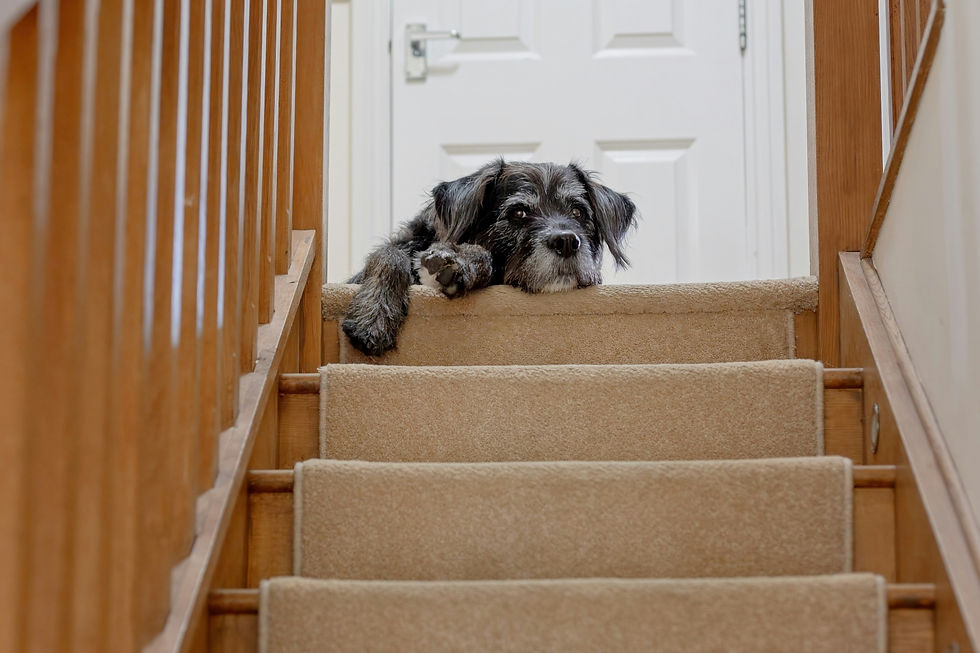
Photo by Natalie Kinnear on Unsplash
I know it well. My senior dog, Haka—a large lab mix—started struggling with the stairs in our home, and watching it happen used to fill me with a deep, gnawing worry. I'd watch as he'd place one front paw on the rise, tremble slightly, and then pull back, letting out a soft whine that cut right through me. Sometimes he would try again, pushing through the pain to get to where we were, but by the time he reached the top, he was panting heavily, looking less like he had climbed a few steps and more like he had conquered Mount Everest.
It wasn't just about the physical effort in the moment. It was the fear of what came next. Haka is a big boy, and as much as I love him, I know my own limits. The thought of the day when he might not be able to make it up those stairs anymore—even with my help—was terrifying.
What would we do then? He's too heavy for me to lift. How would he access his favorite spots? Would our home become a barrier instead of a sanctuary?
Those questions kept me awake at night.
If you're living in Annapolis or Ft. Meade and watching your stiff senior dog struggle with the stairs in your townhouse, please know you are not alone. This scenario is so common among our mobile rehabilitation clients that we've made it a cornerstone of our in-home consultations. It's a challenge we see every day—and more importantly, it's a challenge that often has solutions.
What Does "Mobility Rehabilitation" Actually Mean?
When we talk about canine rehabilitation, especially for seniors struggling with stairs, it sounds a bit clinical. But here's the truth: it's really just helping your dog move better without pain.
Think of a dog's body like a well-loved car. After 10, 12, or 15 years, the joints might get a little stiff, the tires might wear unevenly, and the engine (muscles) might lose a bit of power. Rehab isn't about fixing everything overnight; it's about tuning up the engine and adjusting the suspension so the ride is smoother. For a dog with arthritis or muscle weakness, climbing stairs is the equivalent of asking an elderly person to run up a flight of steps while carrying heavy groceries. It requires strength they might not have right now.
In-home rehab takes the guesswork out of this equation. By visiting your specific townhouse, I can see exactly where your dog gets stuck. Is it the narrow landing between the first and second floor? The slippery hardwoods near the top? Or is it simply that the step height is too much for sore hips? We develop a personalized plan that works within your space, not a generic gym environment that looks nothing like your home.
Signs Your Dog is Struggling (Even if They Hide It Well)
Dogs are incredible at hiding pain. Evolution has wired them to look fine even when they aren't, so don't wait until they refuse to move entirely. As a dog owner, you need to be a detective. Here are the subtle signs that stairs are becoming a dangerous obstacle course:
The "Take-a-Break" Strategy: Does your dog pause midway up the stairs to sit or lie down? This is a huge red flag that they are fatigued or in pain.
Hesitation at the Top or Bottom: That slow sniffing before taking the first step often indicates fear of slipping or joint discomfort. I watched Haka do this for weeks before I fully understood what it meant.
Slipping or Sliding: If your dog navigates wood floors easily but struggles on carpeted stairs, or vice versa, friction might be part of the problem. Haka once slipped on our bottom stair and slid into the wall hard enough to rattle the whole house. That memory stayed with him—and with me.
Reluctance to Go Up vs. Down: Many dogs find going down harder because it puts immense pressure on the front joints and shoulders. If your dog bounces up but slowly inches down, that's a sign of instability.
Behavioral Changes: Are they sleeping more? Whining after play? Avoiding certain rooms? These are often linked to mobility stress.
Remember, if your dog is giving you a "I don't want to do this" look at the stairs, they probably aren't saying no because they're being stubborn. They're saying it hurts.
Practical Tips for Townhouse Safety
So, what can you actually do today to make life easier for your dog? Here are some immediate modifications you can make in your Annapolis or Ft. Meade townhouse:
Traction is King. Slippery surfaces are the enemy of arthritic joints. Apply non-slip rugs or runners to every stair. Ensure they are securely fastened so they don't become trip hazards themselves. Even a small rubberized mat at the bottom of the stairs can provide the grip confidence a dog needs to start climbing. This was the single biggest improvement we made for Haka—non-slip treads on those bottom steps gave him the grip to push off without sliding, and his confidence came back almost overnight.
Lighting Matters. Senior dogs' eyesight fades, just like ours. Ensure the staircase is well-lit. Motion-sensor nightlights can help your dog navigate safely if they need to go down in the middle of the night without squinting in the dark.
Strategic Gates. This sounds counterintuitive, but restricting access can actually keep your dog safe. Install baby gates to limit stair usage to times when you are present to assist. This prevents them from attempting a climb when they're too tired or wobbly to do it safely.
The "Bottom-Up" Exercise. You can build leg strength right at the foot of the stairs. Ask your dog to sit, then stand, using a treat to lure them into a gentle upward motion. This strengthens the hindquarters without forcing a full flight climb.
The "Hand-Under-Belly" Assist: A Skill for Today and Tomorrow
When Haka first started struggling, he needed my hand under his belly on every step. He was hesitant, weak, and the fear of slipping kept him frozen at the bottom.
But today? That story has changed. Thanks to consistent pain management and targeted strengthening exercises for his hind leg muscles, Haka no longer needs that physical lift to navigate our stairs. He moves with a confidence we haven't seen in months.
However, knowing how to assist is a vital part of any long-term mobility plan—and it's a skill every senior dog owner should master.
Why? Because joints can flare up. Muscles can fatigue after a busy day. Or, simply as time goes on, the level of support needed may change again. Having a technique ready ensures you are never caught off guard if a bad day strikes or if you need to help your dog onto a curb or into a car.
The "Hand-Under-Belly" method is all about stability, not lifting.
Position: Keep one hand gently under your dog's collar or harness to control their head and speed. The other hand goes under their belly. An alternative is to use a sling under the belly to assist. This really helps to prevent back pain in the human caregiver over time.
Support, Don't Lift: Your goal isn't to carry their full weight. Instead, apply just enough upward pressure to take the load off their weakest joints.
Stabilize: Use your body to steady them as they move step-by-step. We count the steps together, moving slowly.
Trust the Work: This technique allows the dog's own muscles to do the heavy lifting, which is essential for building the strength we talked about earlier.
For us, this is now our "just-in-case" protocol. But for many families reading this, it might be the lifeline they need today to get their best friend up to the couch safely. Whether you are teaching your dog to stand tall again, or helping them through a moment of weakness, this supportive touch keeps them safe while respecting their dignity and encouraging their independence.
How We Help from Right Here in Your Home
This is where our mobile service shines. When we come to your home in Annapolis or the Ft. Meade area, we don't just give you a list of exercises to memorize, we assess each individual dog and start where they need help the most.
First, we assess your dog's gait and range of motion. Then, we look at your specific stair geometry. Maybe the risers are too high, or maybe there's a wall your dog can lean against with your help. We'll teach you how to support their hind end correctly—lifting gently under the belly, not pulling on the leash—to take the weight off their weak legs.
We also design a customized home exercise program. This might include balance pads, gentle stretching routines you can do while watching TV, or hydrotherapy recommendations if you're near a safe water source. We focus on building the muscle mass needed to stabilize those painful joints. And yes, we'll probably laugh a few times when your dog does a silly stretch or gets distracted by a toy. Keeping things light and fun helps your dog relax, which is half the battle.
Planning for What Comes Next
I still worry about the day Haka can no longer make it up on his own. That fear hasn't fully gone away—but it has been replaced by a plan. We are preparing now. We are discussing main-floor living arrangements. We are looking into ramps and assistive devices for larger dogs. And most importantly, we are working every day through targeted rehab exercises to keep his muscles as strong as possible, for as long as possible.
The goal of canine rehabilitation isn't just to extend life. It's to extend healthspan—ensuring that even as a dog ages, they retain their dignity, their ability to move, and their connection to the places they love.
When Should You Call Us?
Here's the gentle truth: waiting until your dog refuses to walk is waiting too long. The earlier you intervene, the longer your dog stays active and happy.
If you notice hesitation, slipping, or stiffness in the mornings, it's time to reach out. Specifically, if your dog is struggling with stairs in a multi-story home, call us to schedule a mobile consultation. We can come to your doorstep in Annapolis or Ft. Meade, bring the clinic to you, and create a safety plan that respects both your home and your dog's dignity.
You don't have to watch your best friend struggle up those stairs alone. With the right support, a multi-story home doesn't have to mean a restricted life for your senior pup. Let's work together to make sure every step they take is a confident one. Give us a shout today, and let's get those tails wagging freely again.
P.S. If your dog manages to nap on all three floors in one day, send us a photo. We need that kind of inspiration!
About the Author Hi! I am Dr. Megan Keller, a veterinarian and certified canine rehabilitation therapist providing mobile services throughout Fort Meade and Annapolis, MD. My mission is to empower dog owners with the knowledge and tools to improve their pets' mobility and quality of life, regardless of age or condition.
If you're struggling with stairs, joint pain, or mobility issues, let's talk!


Comments