The Tug-of-War: Balancing a Playful Puppy with a Senior Dog in Need of Rehab
Updated: Sep 14

Photo by Jairo Alzate on Unsplash
The Tug-of-War: Balancing a Playful Puppy with a Senior Dog in Need of Rehab
The sound is unmistakable. It's a thundering rhythm of claws on hardwood, followed by the sudden, sharp screech of paws losing traction.
In my home, this symphony of chaos used to play out daily. On one end of the spectrum sits Haka, my senior dog.
Haka lives with severe knee arthritis, a condition that turns every step into a calculated negotiation with gravity. On the other end is Meru, a younger dog whose idea of fun involves launching herself up and down the staircase at forty miles per hour, hoping to snatch a toy—or perhaps Haka's legs—out from under him mid-stride.
For years, we lived in a constant state of architectural engineering. I had to baby-gate off sections of the house just to create a "roughhouse zone" for Meru, a safe space where her zooms wouldn't result in a collision course with Haka. But the real breakthrough came when we realized that simply separating the dogs wasn't enough; we had to change our behavior. We developed a new household rule: Dogs must follow slowly behind humans.
It sounds simple, but it changed everything. By controlling the pace myself, I ensure that Meru doesn't bolt past Haka and that Haka doesn't slip on the bottom stair—a spot he knows well only because he once slid into the wall there, hard. Now, everyone moves at the speed of the slowest walker.
If you are reading this, you might be living a version of this story. Perhaps you have a multi-dog household like Ashleigh's, who balances an energetic Hershey with a sensitive Luna. Or maybe you're just starting your journey with canine rehabilitation therapy. Welcome. You are not alone. The challenge of keeping a young dog active while managing a senior's pain is one of the most common struggles in dog ownership, and it requires a delicate, loving balance.
Today, we're going to talk about how to manage that balance without sacrificing the joy of having two (or more) very different dogs in your life.
The Walk That Works for Two (Or Three...)
One of the things that surprised me most when starting rehabilitation work is how unpredictable each dog can be on leash. What many people assume about seniors versus younger dogs often flips on its head—and in my household, it did.
On paper, I expected Haka (my senior with severe knee arthritis) to move slowly, shuffling along as if every step weighed a ton. Instead, Haka is all business. He wants to trot, to cover ground, to see as much of the countryside as possible before the day is done. There's something heartbreaking and beautiful about watching a senior dog try to outrun his limitations, driven by the knowledge that these moments are precious.
Meru, on the other hand, is the chill partner of the pair. She meanders. She stops to sniff. She deciphers the news of the neighborhood, one blade of grass at a time. To watch her walk is to witness a masterclass in patience and curiosity.
So how do you walk them together? The answer lies in modification, not elimination. For us, parallel walking with distinct leashes has been a game-changer. I use a shorter lead for Haka to encourage his steady, rhythmic gait—which helps reduce the impact of his arthritis while still allowing him the trot he craves. For Meru, I use a longer lead that allows her some range of motion and sniffs, but keeps her close enough that she can't drift too far ahead or lag behind too far.

Opposite energies on leash: Haka wants to explore fast; Meru wants to savor every sniff.
Sometimes, we split the walk entirely. Maybe Haka gets his brisk twenty-minute route through the fields while Meru takes a ten-minute "sniffari" near the driveway. When we combine them, we start with Meru's slower pace to let her burn mental energy, then bring Haka in for his faster lap once the adrenaline has settled. It's not perfect, but it honors what each dog needs in that moment.
Designating Space: Where to Roam and Where to Rest
Your home is your dogs' world, and for a mixed-energy household, zoning is key. Think of your home like a city: some districts are for construction, others for quiet parks.
Shared spaces need to be mobility-friendly. If you have hardwood floors, non-slip rugs are your best friend. Not only do they protect Haka's joints from the shock of slipping, but they also teach Meru to slow down when she enters a transition zone. When we implemented the "follow humans" rule on the stairs, we added treads to the steps to increase grip. This small change reduced Meru's reckless sliding and gave Haka the confidence to navigate without fear.
For playtime, we use baby gates to separate "high-activity zones" from "rehab zones." Meru can chase a flirt pole in the backyard or in a gated-off living room area. Meanwhile, Haka can rest on his orthopedic bed in a quieter corner without worrying about a flying puppy colliding with his sensitive knees. It's not about isolation; it's about creating environments where every dog can be themselves safely.

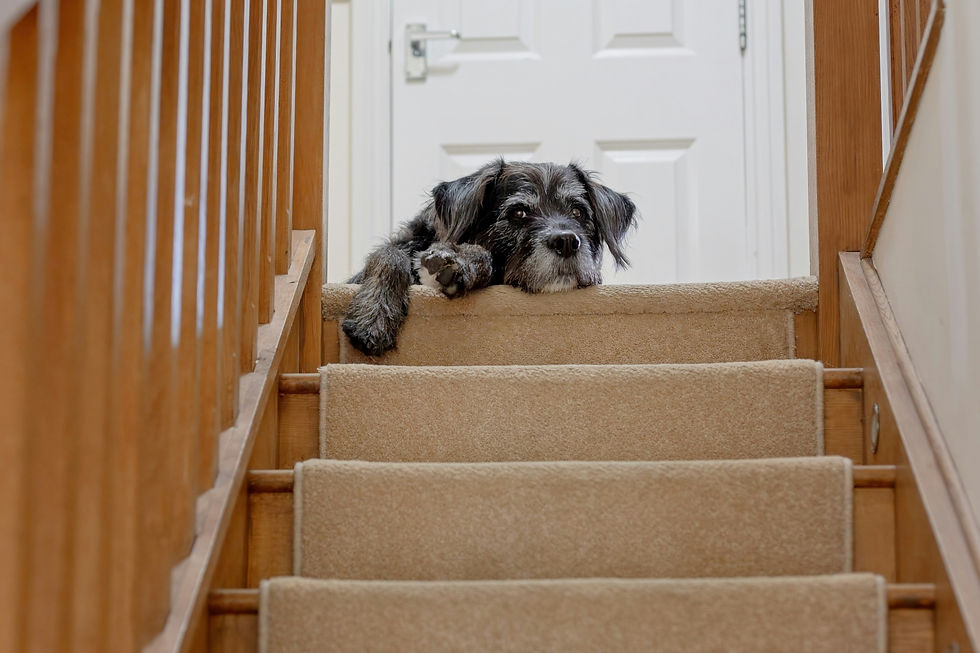
Zoning for safety: Control access to stairs to prevent slips or the hard impact or running down them.
Fueling Different Stages of Life
What we feed our dogs is just as important as how we move them. A senior dog like Haka has different nutritional needs than an adult like Meru. Joint health is heavily influenced by diet, particularly regarding anti-inflammatory nutrients and protein quality.
Seniors often require diets higher in Omega-3 fatty acids (found in fish oil) to combat the inflammation associated with arthritis. They may also benefit from supplements containing glucosamine and chondroitin, which support cartilage health. However, we must be careful not to overfeed; extra weight puts exponentially more pressure on arthritic joints.
Conversely, younger dogs need adequate protein and calories to maintain muscle mass for their activity levels. While joint supplements can certainly help a young dog like Meru, the focus should be on maintaining a lean body condition so she doesn't strain her developing joints later in life. Always consult your veterinarian before making major dietary changes, especially when managing multiple dogs with different caloric needs. Sometimes, feeding separately is necessary to ensure each dog gets exactly what they need without competition.
Why "Active Longevity" Starts Young
Here is a truth that often surprises people: Preventative joint care starts the moment you bring a dog home, regardless of age.
We tend to think of rehab as something for older dogs, but "active longevity" training begins early. Teaching Meru now to navigate stairs safely, to walk on uneven surfaces without tripping, and to respect boundaries sets the foundation for her future mobility. Muscles built now will cushion her joints ten years from now.
When you train a young dog to understand their body, you aren't just preventing injury; you are teaching them self-control. A dog that knows how to move gracefully is less likely to tear a ligament during a game of fetch or suffer a fall on the stairs. By modeling good habits now, you are ensuring that when Meru reaches her twilight years, she won't be limited by injuries that were entirely preventable.
And for seniors like Haka? Respect their drive. Even with arthritis, moving with purpose matters. Controlled exercise keeps muscles strong, which supports joints better than complete rest ever could. Your senior isn't "too old" to keep trying—they just need you to guide them safely.
The Takeaway
Living with a mix of energy levels isn't always easy. There are days when the chaos feels overwhelming, or when Haka's pain seems to limit the fun we can all share. But the effort you put into protecting their joints today pays dividends in their quality of life tomorrow.
By modifying walks, zoning your home, adjusting nutrition, and prioritizing preventative care, you are building a legacy of health for your pack. Whether it's Haka finding relief from his arthritis or Meru learning to channel her energy safely, every small adjustment counts.
Remember, you don't have to figure it all out overnight. Start with one change—maybe just the stairs, or the food bowls—and build from there. Your dogs are watching you for guidance, and with your patience and love, they will learn to thrive in this beautiful, balanced ecosystem you've created.
About the Author I'm Dr. Megan Keller, a veterinarian and canine rehabilitation therapist serving the Fort Meade to Annapolis area, dedicated to helping dogs of all ages improve their mobility and health span. Follow along for more tips on navigating the joys and challenges of a multi-dog household.


Comments